Characterizing existing drugs and predicting new targets in vivo, at scale.
Almost no drugs have been tested across a full lifespan in a complex animal, because it takes too long and costs too much. Smart Tanks, a new platform out of Harvard Medical School, does it: existing compounds get fully characterized on up to 20 parameters in Daphnia, a cheap-to-breed freshwater crustacean. Data from each run, combined with kinase maps and protein structure modeling, trains the model that predicts new human-relevant targets.
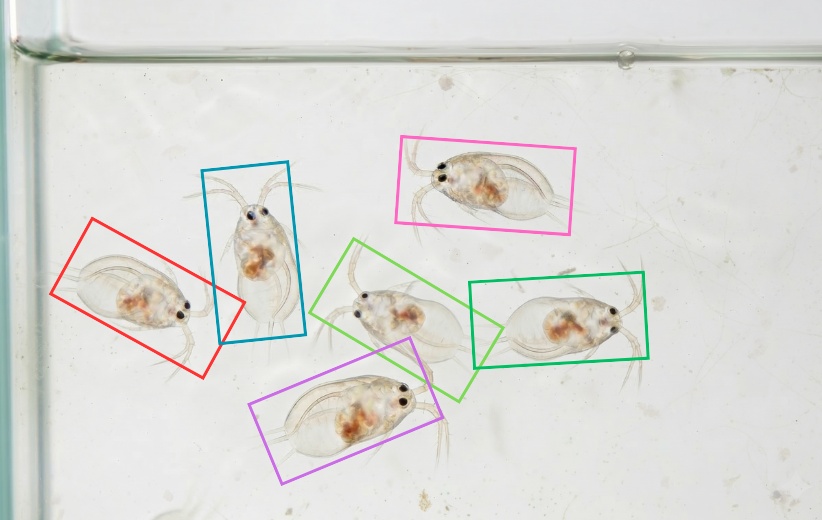
Speed, size, opacity, response to light and other parameters, tracked and scored automatically.
Why Daphnia
All models are wrong, but some are useful, and Daphnia is wrong in two specific ways: it is an arthropod rather than a mammal, so a mouse study is still needed before anything goes further, and because compounds are delivered in water, only what dissolves can be tested. But here is how it compares to other models.
What This Enables
A lab-in-the-loop discovery engine that turns whole-organism signals into ranked human-relevant targets and actionable compound paths.
Characterizing existing drugs
Water-soluble drugs or drug combinations are scored on up to 20 parameters over a full lifespan.
Designing new molecules
A panel of inhibitors ranks the kinases behind the lifespan response, and new molecules are designed against the top of that list.
Founding Team
Daphis Therapeutics combines an MIT- and Harvard-based scientific origin, published proof behind the platform, drug-development judgment shaped inside large biopharma, and the execution range that comes from prior founding experience.
Enter key to reveal founder cards